
Cranking back the years
Lots of stuff seems retrograde right now

Two weeks ago, I saw Avatar: Fire and Ash in resplendent 3D. Some might say the Avatar movie series is big, blue, and bold. Others: boring, banal, and blue. No matter where you may land on the alliterated Avatar spectrum, it’d be a difficult sell to convince anyone the movies’ plots are particularly innovative. An amalgam of our favorite natives versus colonists movies like Braveheart, Fern Gully, Dances with Wolves, etc., what the movie lacks in innovative plot lines, it more than makes up for with 3-dimensional visuals which transport you to Pandora, the series’ fictional, habitable, extrasolar moon in the Alpha Centauri System.
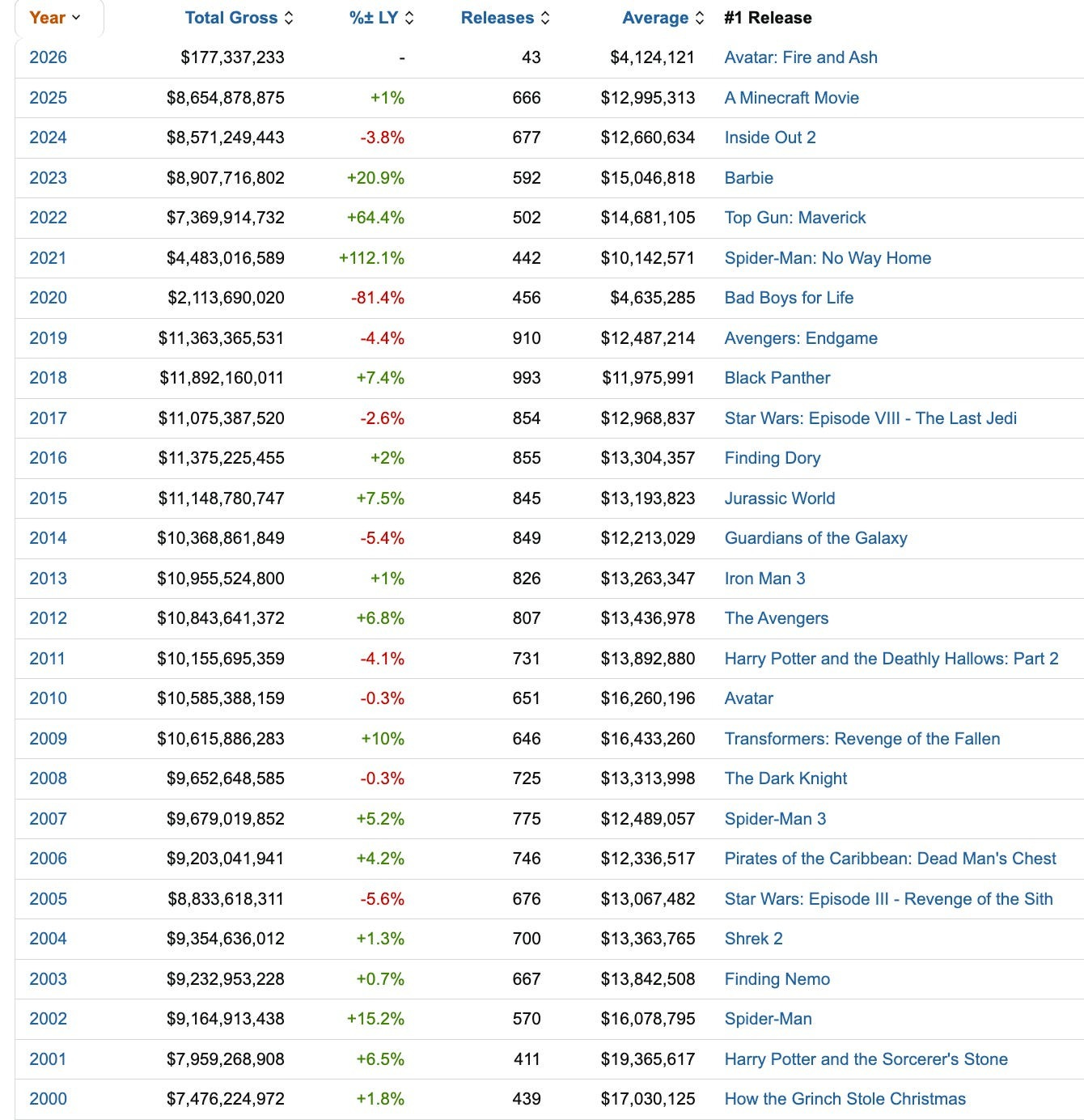
As I write this, Fire and Ash is the top grossing movie of 2026. Say what you will about its derivative plot, Avatar, the first entry in the series, is the only movie since 2000, besides Finding Nemo, to top the box office and not be a sequel or come from pre-existing intellectual property.
It’s not just movies. In 2024, ‘Catalog’ tracks, so called because they’re older than 18 months, have a 76% share of the streaming market. Thought of differently, less than 1/4th the streams in the U.S. are what would be considered ‘new’ music. 76% is a 3.3% year over year increase from 2023. Personally, I’ve witnessed a massive resurgence in popularity of one of my favorite bands, Deftones. Deftones formed in 1988 and first went platinum with 1997’s Around the Fur. As of this writing, the album’s #3 on Billboard’s Top Hard Rock Albums chart.

While music and movies don’t encompass all of culture, in terms of eyeballs and dollars, they certainly take top billing. Given where they’re headed, it seems that culturally, whether it be making or consuming, we’re losing interest in trying new things.
Is it really any surprise then that ‘Making America Great Again’, a political movement whose ethos is that the best version of America already happened, is so popular? Many of the movement’s attempts at regression have been successful–abortion bans, de-regulation, a psuedo-gestapo rounding up what it considers undesirable minorities, I could go on. All of these things have already happened at some point in America’s past, albeit within the last century.
What we’re witnessing presently, with Trump’s desire for Greenland, cranks the clock back all the way to the annexation of Hawaii, right before the turn of the 20th century. It marks the last time America invaded and annexed territory to become part of the U.S. It bears mentioning that while similar territorial acquisitions took place in the Philippines and Cuba around the same time, neither became part of the U.S.
The most recent historical analogy to Trump’s desire for Greenland is the 1803 Louisiana Purchase. Both Greenland and the Louisiana Purchase involved presidents with land-lust who sought large territories primarily for the sake of their size, and secondarily for their natural resources. For the inhabitants of each, there’s a major difference: Greenland has democratic self-determination, a privilege the colonists and natives living in the Louisiana Purchase lacked.
“No man ever steps in the same river twice, for it’s not the same river and he’s not the same man.” —Heraclitus
This distinction is important because it cranks the clock back even further, potentially to a time outside of American history. A time when the leadership of a nation took something simply because it wanted to and it could. And while some might point to the founding of this country as such an operation, that was instigated by dusty old England.
Understanding the lack of American historical analogies, or even modern democratic analogies, puts into sharp relief how retrograde Trump’s desire for Greenland actually is. This base cruelty, and that there’s support for it inside and outside of government, shows us just how much of an accelerated regression is taking place across America’s cultural and political thinking.
The reason why these sorts of ego-driven land grabs haven’t happened much in the past 100 years is because a certain amount of isolation is required for success. Slower communication and travel, and a lack of trading dependencies and global political norms all meant an invasion would have fewer and narrower repercussions. This makes even more sense as America, through the Trump administration’s work, recedes further from the world’s stage to focus on regional boondoggles like kidnapping Maduro or blowing up seafarers at will in South and Central America.
While I doubt we’ll soon all be listening to Mozart and his contemporaries en masse anytime soon, or books retaking television’s throne, I do suspect that for as much as we feel history is happening ever more quickly, it’s in many ways slowing down. Wherever this takes us, I’ll still be listening to Deftones.
Nostalgia is a key characteristic of fascism, but I still think you are right that this wave is especially nostalgic and particularly unoriginal. They don't even bother to create new slogans, they just translate them from other cultures or dig them up from decades ago.
"Avatar, the first entry in the series, is the only movie since 2000 to top the box office and not be a sequel or come from pre-existing intellectual property"
I think your point still stands, but this should be "since 2003" not 2000: Finding Nemo is an original story/idea and it was #1 at the box office in 2003.